Introduction to 6G
The sixth generation (6G) of mobile networks represents the future of wireless communications, expected to be deployed around 2030. While still in the research and development phase, 6G is envisioned to revolutionize connectivity by integrating communication, computing, and sensing capabilities into a unified network infrastructure.
The development of 6G is being driven by the need to support emerging technologies and applications that will require unprecedented levels of performance, including holographic communications, advanced artificial intelligence, and the Internet of Senses. Major research initiatives are underway globally, with countries like China, Japan, South Korea, and the United States leading the development efforts.
6G networks are expected to utilize terahertz (THz) frequencies (100 GHz to 10 THz) for ultra-high-speed communications, while also leveraging artificial intelligence and machine learning for network optimization and management. The technology aims to achieve terabit-per-second speeds, microsecond-level latency, and support for up to 10 million connected devices per square kilometer.
The vision for 6G extends beyond traditional mobile communications to create a truly intelligent and integrated network that can sense, learn, and adapt to user needs in real-time, enabling new applications and services that are currently beyond our imagination.
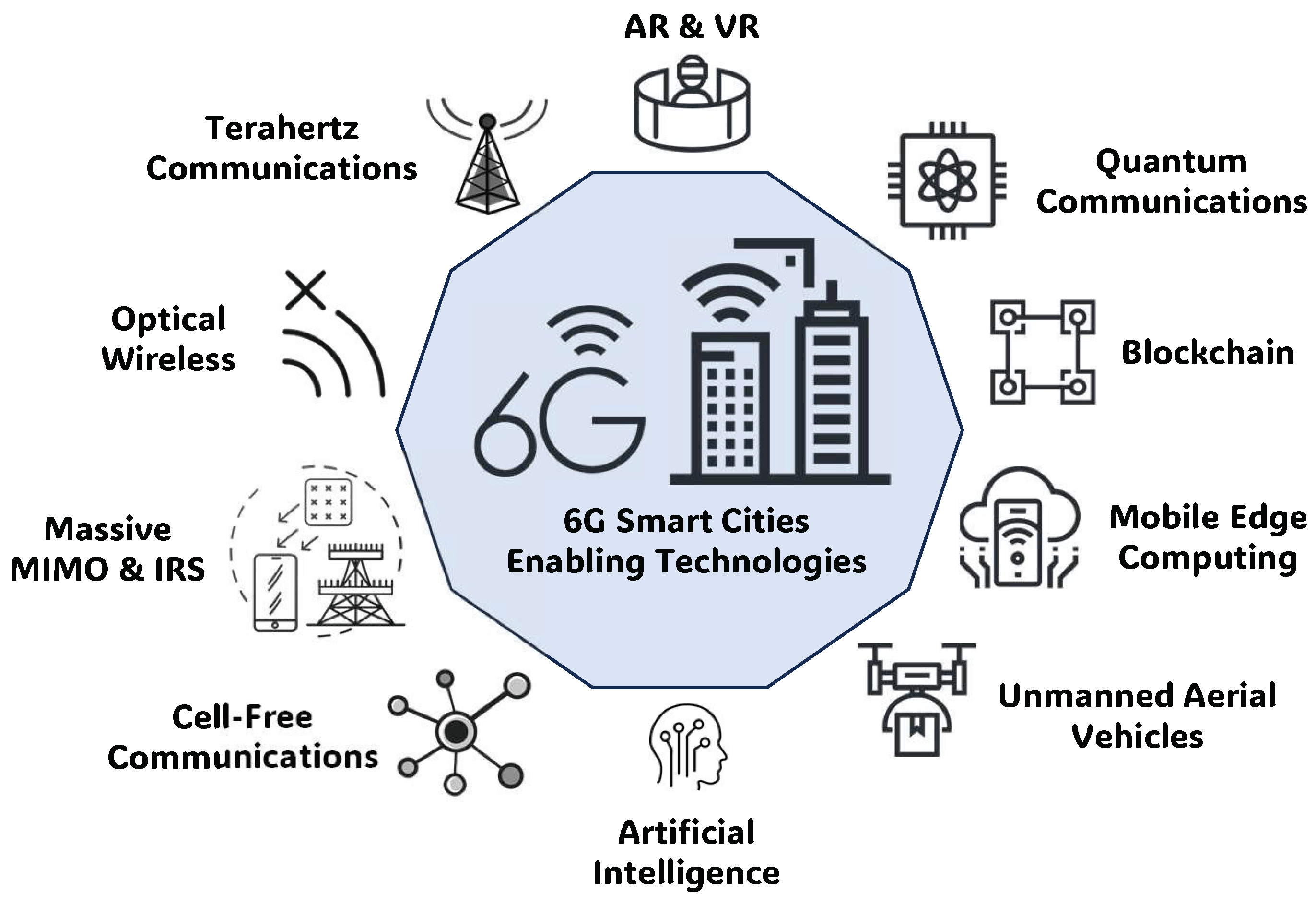
Conceptual visualization of 6G network infrastructure and applications.
Technical Specifications
Data Speeds
Expected peak speeds of 1 Tbps, with typical speeds of 100 Gbps in real-world conditions.
Latency
Ultra-low latency of 0.1ms, enabling real-time holographic communications and control.
AI Integration
Native artificial intelligence and machine learning capabilities throughout the network.
Coverage
Integrated terrestrial and non-terrestrial networks for global connectivity.
Global Research and Development
Asia-Pacific
China has launched the "6G Vision and Technology Research" program, while Japan's Beyond 5G Promotion Consortium is working on 6G development. South Korea's 6G Research and Development Program aims to achieve commercial deployment by 2028. These countries are focusing on terahertz communications, AI integration, and advanced network architectures.
North America
The United States has established the Next G Alliance, bringing together industry leaders to advance 6G research. Canada's Communication Research Centre is exploring terahertz technologies and quantum communications. Research institutions and companies are focusing on security, privacy, and sustainable network design.
Europe
The European Union's Hexa-X project is leading 6G research in Europe, with a focus on sustainability and digital inclusion. The 6G-IA (6G Smart Networks and Services Industry Association) is coordinating industry efforts. European research emphasizes energy efficiency, security, and privacy in future networks.
Key Innovations and Impact
Major Innovations
- Terahertz communications for ultra-high-speed data transfer
- Native AI and machine learning integration
- Quantum computing and communications
- Integrated sensing and communications
- Holographic and extended reality technologies
Potential Applications
- Holographic telepresence and communications
- Digital twin technology for real-time simulation
- Brain-computer interfaces and neural communications
- Autonomous systems and smart environments
- Internet of Senses and immersive experiences
Social and Economic Impact
6G networks are expected to transform society by enabling new forms of communication, collaboration, and interaction. The technology will support advanced healthcare applications, sustainable smart cities, and immersive education experiences. The economic impact could be even greater than 5G, with estimates suggesting that 6G could contribute tens of trillions of dollars to global GDP by 2035. The technology will also play a crucial role in addressing global challenges such as climate change, healthcare access, and digital inclusion.
Potential Impact
Internet of Senses
Enabling multi-sensory communication and experiences
Digital Twins
Creating real-time digital replicas of physical systems
Advanced AI
Supporting next-generation AI applications and services
Research Challenges
Hardware
Developing terahertz-capable devices and components
Security
Ensuring quantum-resistant security protocols
Standardization
Establishing global standards and regulations
Future Vision
6G networks are expected to transform how we interact with technology, enabling new paradigms in communication, computing, and human-machine interaction. The technology is still in its early stages, with research and development ongoing worldwide.