Introduction to 5G
The fifth generation (5G) of mobile networks represents a revolutionary leap in wireless communications, introduced in the late 2010s. Defined by the International Telecommunication Union (ITU) under the IMT-2020 standard, 5G networks are designed to deliver ultra-fast speeds, ultra-low latency, and massive device connectivity.
The first commercial 5G networks were launched in 2019, with South Korea's SK Telecom and KT being among the first operators to deploy nationwide 5G services. Verizon followed shortly after in the United States, marking the beginning of the global 5G era. The development of 5G was driven by the need to support emerging technologies like the Internet of Things (IoT), autonomous vehicles, and augmented reality applications.
5G networks utilize three main frequency bands: low-band (below 1 GHz), mid-band (1-6 GHz), and high-band millimeter wave (24-100 GHz). This multi-band approach allows for a balance between coverage and capacity, with millimeter wave providing ultra-high speeds in dense urban areas and low-band ensuring wide coverage in rural regions.
The technology is designed to support peak download speeds of up to 20 Gbps and latency as low as 1 millisecond, enabling real-time applications and services that were previously impossible on mobile networks.
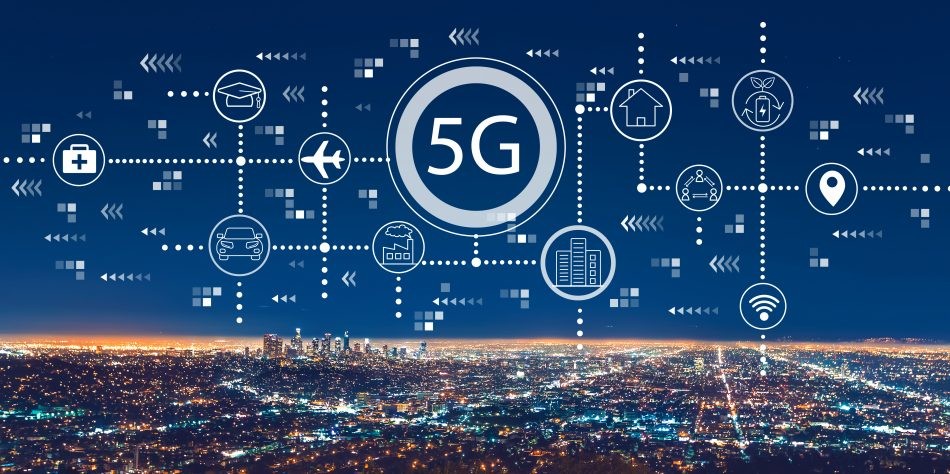
5G infrastructure enables ultra-fast connectivity and supports emerging technologies.
Technical Specifications
Data Speeds
Peak speeds up to 20 Gbps, with typical speeds of 100-900 Mbps in real-world conditions.
Latency
Ultra-low latency of 1-10ms, enabling real-time applications and services.
Network Slicing
Virtual network segmentation for customized service delivery and resource allocation.
Massive MIMO
Advanced antenna technology supporting up to 100x more connected devices per area.
Regional Development
Asia-Pacific
South Korea and China led the 5G deployment race, with both countries launching commercial services in 2019. South Korea achieved nationwide coverage within months, while China's three major operators (China Mobile, China Telecom, and China Unicom) rapidly expanded their 5G networks. Japan and Australia followed with their own deployments, focusing on urban areas and key business districts.
North America
The United States saw aggressive 5G deployment from major carriers, with Verizon focusing on millimeter wave technology for ultra-high speeds and T-Mobile emphasizing nationwide coverage using low-band spectrum. Canada's major operators began 5G deployment in 2020, with a focus on major urban centers and industrial applications.
Europe
European countries adopted a more measured approach to 5G deployment, with the European Union setting ambitious targets for 5G coverage. The UK, Germany, and France led the way, with operators focusing on both urban and rural coverage. The EU's 5G Action Plan aimed to ensure 5G coverage in all urban areas and major transport paths by 2025.
Key Innovations and Impact
Major Innovations
- Network slicing for customized service delivery
- Massive MIMO and beamforming for improved capacity
- Edge computing integration for reduced latency
- Advanced antenna technologies and millimeter wave spectrum
- Software-defined networking and network function virtualization
Use Cases and Applications
- Enhanced Mobile Broadband (eMBB) for ultra-fast internet access
- Ultra-Reliable Low-Latency Communications (URLLC) for critical applications
- Massive Machine-Type Communications (mMTC) for IoT devices
- Industrial automation and smart manufacturing
- Autonomous vehicles and smart transportation
Social and Economic Impact
5G networks are transforming industries and society by enabling new applications and services. The technology is driving innovation in healthcare, manufacturing, transportation, and entertainment. The economic impact is significant, with estimates suggesting that 5G could contribute trillions of dollars to global GDP by 2030. The technology is also playing a crucial role in digital transformation, enabling remote work, virtual education, and telemedicine on an unprecedented scale.
Impact on Society
Smart Cities
Enabling connected infrastructure, traffic management, and public services
Healthcare
Supporting telemedicine, remote surgery, and real-time patient monitoring
Industry 4.0
Transforming manufacturing with connected factories and automation
Challenges and Limitations
Infrastructure
Requires dense network of small cells and new infrastructure
Security
Increased attack surface and security concerns
Investment
High deployment and maintenance costs
Evolution to 6G
5G networks are paving the way for 6G, which is expected to bring even more advanced capabilities, including terahertz communications, advanced AI integration, and quantum computing applications.